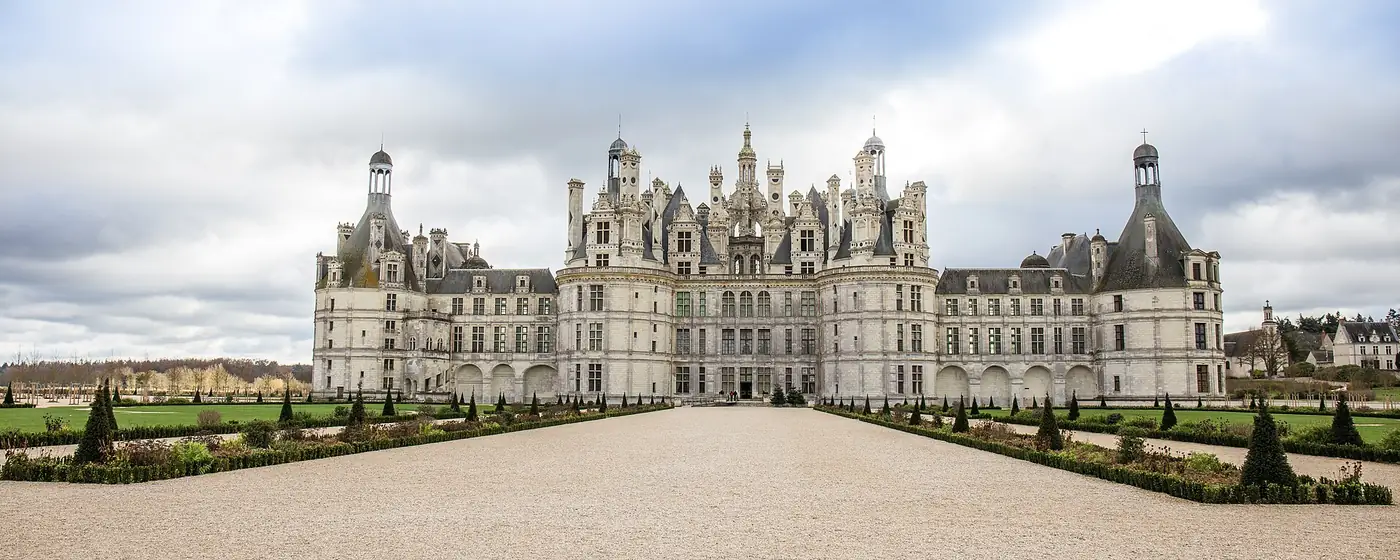
September 1519. On a Sologne marsh that nothing marked out for glory, Francis I has the first stone laid of a château he will never really have the use of. Four hundred and forty rooms, three hundred and sixty-five chimneys, eighty-four staircases. The king will stay there for less than two months in thirty-two years.
You do not arrive at Chambord, you receive it. A forest avenue, a bend, and the whole façade at once. Visiting Chambord means spending the rest of the day trying to understand it.
The staircase, and the doubt worth keeping
Two flights wound one around the other. Two people going up and coming down, catching each other’s eye through the open core, never meeting. It is the centrepiece, and it is also the finest legend trap in the Loire Valley.
You will be told that Leonardo da Vinci designed it. The estate’s own page on the question is headed “Léonard de Vinci, architecte de Chambord ?” (Leonardo da Vinci, architect of Chambord?), question mark included. The facts are stubborn. Leonardo reaches Amboise in October 1516 at the king’s invitation, dies at the Clos Lucé on 2 May 1519, and the building site opens in September of the same year, four months after his death. Every document of the period calls him “painter to the king”, never architect. The famous title of “first architect” rests on a burial record fabricated in 1863, whose original has never resurfaced.
The influence remains likely, the notebooks do contain those principles, but no archive establishes it. A fine story, and one that deserves to be told straight.
What not to miss
The royal lodgings, the 18th-century kitchens, the lantern tower, Marshal de Saxe’s stables. And the terraces, above all. It is from up there that the château makes sense: a forest of chimneys, dormers and turrets, a vertical town set down on the woods. Five minutes at the top are worth an hour of commentary.
The formal gardens reopened in March 2017 after seven months of work, six and a half hectares restored from a plan of 1734 and from geophysical surveys. They had been gone since the 1970s. To them are added permaculture kitchen gardens and the Ormetrou vines.
The estate, which is always underestimated
Five thousand four hundred and thirty-three hectares. A wall of thirty-two kilometres, begun in 1542: the largest enclosed forest in France. A national hunting and wildlife reserve since 1947, a Natura 2000 site since 2007.
From April to early November you can hire an electric boat, twenty-two euros for half an hour for up to five people, bicycles, seven euros an hour for an adult, a four-wheeled pedal car or an electric buggy. Around ten wildlife hides are open to all, free of charge: wild boar and deer show themselves early in the morning or at nightfall.
In mid-September the red deer rut begins. The estate runs guided outings of two hours that last until dusk, sixteen participants at most, booking by telephone from 1 June. Seven hundred deer live in the park. It is the finest moment of the year in Sologne, and the shortest.
2026 opening times, with one change
| Period | Opening times |
|---|---|
| 4 January to 27 March | 9am to 5pm |
| 28 March to 25 October | 9am to 6pm |
| 26 October to 18 December | 9am to 5pm |
| 19 December to 2 January | 9am to 6pm |
Closed on 1 January and 25 December. And above all, a 2026 change that you will read nowhere else: eight winter Mondays are closed, 5, 12, 19 and 26 January, 2 February, 9, 16 and 23 March. Chambord is therefore no longer open three hundred and sixty-three days a year.
2026 prices, and the car park everyone forgets
Château and gardens, €21 full price, €18.50 reduced. Since 1 January 2026, visitors resident outside the European Economic Area pay €31.
Free for under-18s, for 18 to 25-year-olds who are nationals or residents of the European Economic Area, for visitors with a disability and the person accompanying them, for primary and secondary school teachers and for people on means-tested benefits.
The car park is not free: €8 for the day, €15 for a campervan, free for bicycles and for visitors with a disability. The three car parks are six hundred, seven hundred and fifty and eight hundred and fifty metres from the château. Pay at the machine as you arrive rather than on the way back, because the queue forms just as everyone is leaving.
The HistoPad, an augmented reality tablet that refurnishes some twenty rooms and sets children a treasure hunt from the age of five, is hired separately. The day pass at €38 bundles admission, the equestrian show, the HistoPad and a set of discounts: it becomes worthwhile as soon as you are planning on the show.
The dates for 2026
The equestrian show “Chambord, l’histoire à cheval” (Chambord, A History on Horseback) runs from 4 April to 27 September, then from 17 October to 1 November: forty-five minutes, ten horses, eight riders, staged by Mario Luraschi and narrated by Jean Dujardin.
The Festival de Chambord, classical music under the direction of Vanessa Wagner, from 4 to 11 July. The exhibition Les Festins de Chambord (The Feasts of Chambord) from 26 September, which traces the history of gastronomy back to the 16th century. And from 28 November to 17 January, a Christmas placed under the sign of Gargantua: appetite, abundance, excess. The theme fits the place like a glove.
Avoiding the crowds
The estate says it itself: the quietest days are Monday, Tuesday and Sunday, the busiest Wednesday to Saturday. On busy days, arrive before 10.30am or after 3.30pm, and buy your ticket online. Simply remember the eight closed winter Mondays, which contradict the advice between January and March.
Allow an hour and a half at the very least for the château alone, four hours with the gardens, a whole day with the show and the activities of the estate.
Dogs on a lead are allowed in the park, and not in the château, the gardens or the stables. Picnics are permitted everywhere, in front of the château as much as in the clearings. Lockers and folding pushchairs are lent free of charge. The ground floor of the keep and the gardens are wheelchair accessible, the upper floors and the terraces are not.
Twenty minutes by car from Cour-Cheverny, by way of Bracieux. Close enough to be there at opening time, far enough for the forest to do its work on the road. Le Clos Amarante holds that precise point on the map, between Cheverny on foot and Chambord before the crowds…
Information checked on 3 August 2026 on the official website of the Domaine national de Chambord. Opening times and prices change: a quick look at chambord.org before you set off.